PRIVATE, CORPORATE AND INDUSTRIAL COLLABORATIONS
The driving mandate of the Wake Forest Institute for Regenerative Medicine is to bring new technologies to the clinic safely and rapidly. The Institute combines aggressive innovation in academic medicine and entrepreneurial technology transfer to create and develop applications that promote health by replacing or repairing tissues and organs damaged by disease, trauma, or congenital conditions. As a leader in translational research, the Institute actively seeks out partnerships with companies in the biotechnology industry.
Previous successful alliances with industry have resulted in more than 11 technologies reaching the clinical testing stage, with many others currently in pre-clinical testing.
The Institute's research programs span the key areas essential to Regenerative Medicine:
- Tissue Engineering
- Cellular Therapy
- Molecular Therapy
- Stem Cells
- Drug Delivery
- Biomaterials
- Nanotechnology
- Cell/Tissue Physiology
- Systems Biology
All of the regenerative medicine research programs are structured to address real world medical problems. The approach is to mobilize within the Institute all of the resources and expertise needed to create innovative technological solutions, refine them in preclinical models of disease, and carry out first-in-man studies. Once initial evidence for safety and efficacy has been obtained, scientists work closely with corporate partners to facilitate further preclinical development, scale-up and the extensive clinical studies required for regulatory approval.
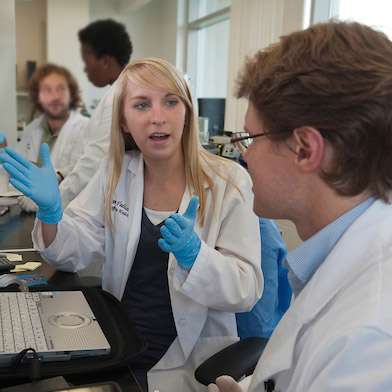
The complex problem of regenerating tissues and organs demands the application of skills from many disciplines. The Wake Forest Institute for Regenerative Medicine functions as an integrated team that includes clinically trained physicians, basic scientists and engineers. In contrast to the territorial "silos" typical of many academic settings, the Institute's faculty, fellows, and graduate students work in a cooperative environment that can be fairly described as a "Laboratory without Walls." The team also benefits from an extensive collaborative network within Wake Forest, in the inter-institutional Virginia Tech-Wake Forest School of Biomedical Engineering, and around the world.
"As a leader in translational research, the Institute actively seeks out partnerships with companies in the biotechnology industry."
Corporate Partners
Important corporate alliances involving sponsored research agreements
for the development of the Institute's technologies already have
been announced. Others are under active discussion, while multiple
opportunities remain open. The Institute's industrial partners
include:
Tengion is the Institute's initial corporate partner for the clinical
advancement of its core technologies in tissue engineering, primarily
in the fields of the genitourinary system and blood vessels. An
agreement between Tengion and the Institute was announced on January
9, 2006 (click here for press release). The partnered program
focuses on the development of neo-organs and neo-tissues generated
from each patient's own (autologous) cells. The use of autologous
cells makes it unnecessary to use immunosuppressive drugs to repress
rejection, as would be required in conventional organ transplantation.
To create a neo-organ or neo-tissue, a small amount of the patient's
tissue is obtained by biopsy, and progenitors of the desired specialized
cell types are recovered and expanded in culture. The cells are
then seeded onto a bioresorbable scaffold which provides shape
and structure. The neo-organ is surgically implanted into the
patient, and the seeded cells continue to grow and differentiate
while the scaffold gradually dissolves away. Over time the regenerated
organ or tissue acquires increasingly normal form and function.
A major goal of the collaboration is the clinical development
of neo-organs for patients with defects in the urinary bladder.
Plureon Corporation has licensed key technology utilizing a novel
class of pluripotent stem cell that derives from pregnancy. These
cells can be isolated harmlessly from routine prenatal specimens
used for genetic testing (obtained by amniocentesis) or from the
placenta at the time of birth. Plureon is developing the cells
for therapeutic and drug discovery applications internally, through
sponsored research at the Wake Forest Institute for Regenerative
Medicine, and through alliances with major biopharmaceutical companies,
including Cryo-Cell and BD (Becton, Dickinson and Company). Based
on inventions by Institute scientists, Plureon also has been awarded
Phase 1 and Phase 2 SBIR grants from the US Army to develop a
keratin bioceramic antibiotic putty for bone regeneration.
Cryo-Cell International, Inc. is the world's largest private bank
for umbilical cord blood. The Company has signed an agreement
with Plureon to offer parents of newborn children the opportunity
to collect and preserve, in addition to cord blood, the novel
fetal stem cells currently under intensive study by Institute
scientists.
Becton, Dickinson & Company, a leading medical technology
company, has entered into an agreement with Plureon to develop
the pluripotent fetal stem cells for treatment of diabetes. (News
here) The program will be carried out in close collaboration with
scientists at the Wake Forest Institute for Regenerative Medicine
through a sponsored research agreement. Institute scientists have
shown that fetal stem cells obtained from amniotic fluid can be
induced to produce insulin-producing cells similar to pancreatic
beta-cells. These cells are deficient in patients with juvenile
diabetes (type 1 or "juvenile" diabetes). In an experimental model
of the disease, injection of these stem cells, primed by introduction
of a pancreatic master gene, restored normal production of insulin
and regulation of blood glucose levels.
A complete list of many of our collaborative partners is included
in this section. Please select the type of partnership you wish
to learn more about below.
Intramural Collaborations
Extramural/Academic Collaborations
Private, Corporate, Industrial Partners/Collaborators:
A significant quantity of Institute resources are funded
through a variety of private foundations and corporate entities.
Acell (www.acell.com/vet.htm)
Advanced Cell Therapeutics (www.advancedcell.com)
AGI Dermatics, Inc. (www.agiderm.com)
AlphaMed Press (www.StemCellsPortal.com)
ALZA (www.ALZA.com)
Amaxa, Inc. (www.biospace.com/company_profile.aspx?CompanyID=390204)
American Medical Systems (AMS) (www.americanmedicalsystems.com)
Arie & Ida Crown Memorial
Becton Dickenson (BD) (www.bd.com)
BioSante (www.biosantepharma.com)
Boston Scientific (www.bostonscientific.com)
Cryo-Cell International, Inc. (www.cryo-cell.com)
DMT, Inc. (www.dmt.dk)
Fisher Scientific (www.fisherscientific.com)
Foster-Miller (www.foster-miller.com)
Frase Foundation (www.joshuafrase.org)
Invitrogen Corportation (www.invitrogen.com)
Juvenile Diabetes Research Foundation (JDRF) (www.jdrf.org)
Musculoskeletal Transplant Foundation (www.mtf.org)
NanoTechLabs Inc. (www.nanotechlabs.com)
Pfizer (www.pfizer.com)
Plureon (www.plureon.com)
Sciperio (www.sciperio.com)
Stemnion (www.stemnion.com)
Stovall Life Sciences, Inc. (www.slscience.com)
Tengion (www.tengion.com)
VWR International, Inc. (www.vwr.com)